
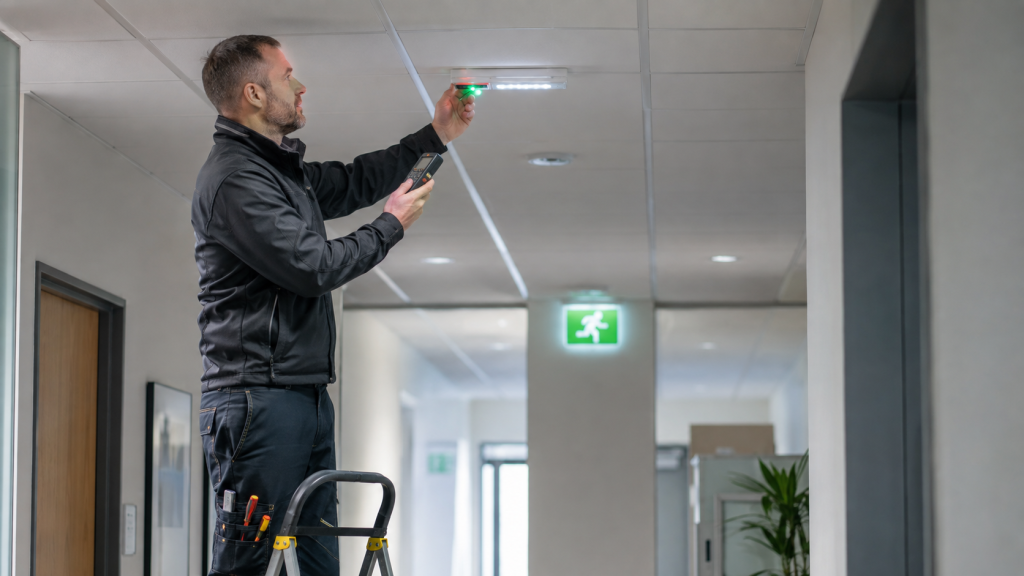
Emergency lighting is easy to overlook because, in normal circumstances, it sits quietly in the background. However, if a fire, electrical fault or power cut causes the main lighting to fail, it becomes a vital part of the building’s safety system.
For employers, commercial landlords and facilities managers, simply having emergency lights installed is not enough. They must work correctly, illuminate the right areas and remain operational for the required period. Regular testing is therefore essential.
So, how often should commercial emergency lighting be tested, and what should each test include?
What is emergency lighting designed to do?
Emergency lighting switches on automatically when the normal lighting supply fails. Its purpose is to help people leave a building safely by illuminating escape routes, stairs, changes in floor level, fire exits, safety equipment and other potentially hazardous areas.
Depending on the premises, the system may include illuminated exit signs, emergency bulkheads and lighting within open areas where people could otherwise become disorientated.
Emergency lighting is particularly important in commercial buildings with internal corridors, windowless rooms, stairwells or areas used outside daylight hours. The precise requirements should be identified through the building’s fire risk assessment.
Is emergency lighting a legal requirement?
The Regulatory Reform (Fire Safety) Order 2005 requires emergency routes and exits that need illumination to have emergency lighting of adequate intensity if the normal lighting fails. Employers must also provide suitable emergency lighting in the workplace where required.
The person responsible for fire safety may be the employer, building owner, landlord, managing agent or another person with control of the premises. In a leased commercial property, responsibilities should be clearly established rather than assumed.
UK guidance for the design and provision of emergency lighting is set out in BS 5266-1:2025. The system should also form part of the premises’ wider fire-safety arrangements and be kept in effective working order.
How often should emergency lighting be tested?
Commercial emergency lighting should normally be checked through two main testing routines: a short monthly function test and a full annual duration test.
Monthly function test
Once a month, the normal lighting supply should be interrupted briefly to confirm that every emergency light operates correctly.
During the test, the person carrying it out should check that:
- Each emergency light switches on
- Illuminated exit signs remain clear and visible
- Fittings are clean and free from damage
- Indicator lamps and charging lights behave correctly
- Escape routes are properly illuminated
- Nothing is blocking or obscuring a fitting
The test should be long enough to check the system, but it should not unnecessarily discharge the batteries. Any fault must be recorded and addressed promptly.
Some premises use a dedicated test switch, sometimes known as a fish-key switch, while others have an automatic self-test system. Automated systems still need appropriate monitoring, and any reported fault must not be ignored.
Annual full-duration test
At least once a year, the emergency lighting system should undergo a full rated-duration test. This simulates an extended failure of the normal lighting and confirms that the batteries can keep the fittings operating for their designed period.
Many commercial emergency-lighting systems are designed to operate for three hours, although the required duration depends on the building and the system specification. The annual test should therefore be based on the system’s actual design requirements.
This test is more demanding than the monthly check and can expose ageing batteries that appear to work for a few minutes but fail well before the full duration has elapsed.
Because batteries need time to recharge afterwards, the annual test should be planned carefully. It may be safer to carry it out when the building is unoccupied or when the risk caused by temporarily depleted batteries can be properly controlled.
Why should test results be recorded?
Every monthly and annual test should be recorded in the building’s fire-safety logbook. The entry should include the date, the type of test, the result, any defects found and the action taken.
Good records provide evidence that the system is being monitored and maintained. They also help identify repeated failures, deteriorating batteries or fittings that regularly require attention.
If a fire-safety inspection takes place, a missing or incomplete testing record could make it difficult to demonstrate that the responsible person has taken reasonable steps to maintain the system.
Common emergency-lighting faults
Emergency lights can appear to be in good condition while hiding faults that only become obvious during a test. Common problems include:
- Batteries that no longer hold a full charge
- Failed lamps or LED units
- Damaged fittings or diffusers
- Missing or unclear exit signs
- Charging or electrical-supply faults
- Lights obscured by stock, furniture or new partitions
- Inadequate coverage following changes to the building layout
Office refurbishments and fit-outs are a common cause of problems. A new meeting room, partition wall or storage area can alter an escape route or block light from an existing fitting. Emergency-lighting coverage should therefore be reviewed whenever the use or layout of a premises changes.
Can monthly tests be carried out in-house?
A straightforward monthly function test may be completed by a suitably instructed member of staff who understands the system, knows what to inspect and records the result correctly.
However, faults, repairs and full-duration testing should be handled by a competent professional. A specialist can check the condition and positioning of the fittings, test battery performance, identify electrical faults and advise whether the existing system remains suitable for the building.
When was your system last tested?
Emergency lighting only proves its value when something has already gone wrong. Waiting for a power failure to discover that batteries are flat or escape routes are poorly lit creates an avoidable risk.
AFM Services provides commercial emergency-lighting support as part of its electrical services. We can help businesses, landlords and facilities managers across Essex, London and the surrounding areas assess their existing system, arrange testing and maintenance, and address faults or outdated fittings.
To discuss emergency lighting for your commercial premises, contact AFM Services on 01277 549082 or email info@afmservicesltd.co.uk.