
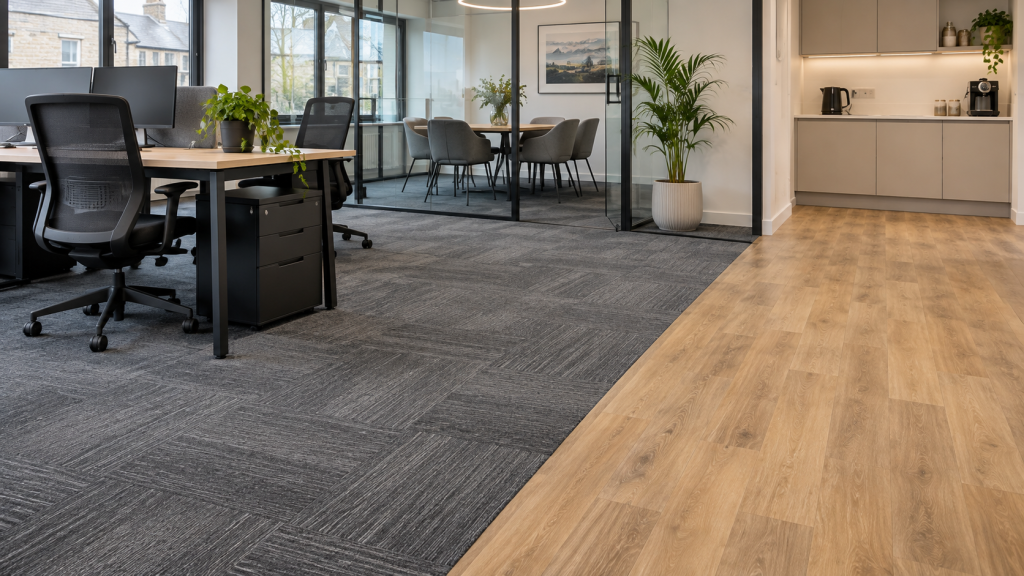
Carpet tiles often suit desk areas and meeting rooms where comfort and sound control matter, while commercial vinyl can be a practical choice for refreshment areas and spaces needing frequent cleaning. Many offices benefit from using both, with each floor covering chosen for the way that particular area operates.
For businesses in Brentwood, Chelmsford and across Essex, choosing office flooring means balancing appearance, maintenance, disruption and cost. The right decision starts with how people use the space each day.
Where do carpet tiles work best?
Carpet tiles are worth considering for open-plan workspaces, private offices and meeting rooms. They provide a textile finish underfoot and, with an appropriate construction and backing, can contribute to controlling noise within a busy workplace.
However, acoustic performance varies between products. Compare the manufacturer’s technical information rather than assuming that every carpet tile offers the same benefit.
The
modular format also makes carpet tiles useful when planning future maintenance. Depending on the installation system, individual damaged tiles can be replaced without renewing the whole room. Keeping spare tiles from the original order can help, although differences in wear may still make replacements noticeable.
For desk areas, check that the chosen product is suitable for commercial use and castor chairs.
When is commercial vinyl a better option?
Commercial vinyl is often worth considering for staff refreshment areas, circulation spaces and other parts of the office where cleaning is a priority.
There are different types, including sheet vinyl and luxury vinyl tiles or planks, commonly called LVT. These have different installation requirements and performance characteristics, so “vinyl” should not be treated as a single specification.
Wood-effect and stone-effect finishes can provide a different appearance from carpet, while products designed for commercial use offer options for busy workplaces.
Match the product to the conditions. An area exposed to spills needs a suitable flooring specification and cleaning routine. A decorative vinyl finish should not automatically be assumed suitable for every wet area.
AFM’s commercial flooring services include vinyl, contract carpets and carpet tiles, giving businesses several options to assess.
Which flooring is easier to clean?
The answer depends on what you need to remove and how the office is maintained.
Carpet tiles usually need regular vacuuming, prompt attention to spills and periodic deeper cleaning. Vinyl generally requires removal of loose dirt followed by cleaning with suitable products and methods.
Before choosing either, ask:
- Who will clean the floor, and how often?
- Are drinks or food regularly carried through the area?
- What equipment and cleaning products will be needed?
- Are there specific manufacturer maintenance instructions?
A floor that suits your cleaning arrangements is more useful than one selected solely from a sample board.
Are carpet tiles cheaper than vinyl?
There is no reliable answer without comparing specific products and the installation work required.
The material price is only one part of the quotation. Removing old flooring, preparing the subfloor, moving furniture and working around occupied areas can all affect the overall cost.
Ask for a quotation that clearly separates the main elements. Compare the same scope of work across proposals, including preparation, fitting, waste removal and any finishing details.
Also consider future maintenance and repair. A lower purchase price does not necessarily mean a lower cost over the time you use the floor.
Can you combine carpet tiles and vinyl in one office?
Yes. Using different flooring in different areas can be a practical way to support the layout.
For example, an office might use carpet tiles around workstations and in meeting rooms, with commercial vinyl in a staff refreshment area.
The junctions need planning. Product thicknesses, floor levels, transition details and the installation system should all be considered before fitting begins.
If you are also moving partitions or changing desk positions, plan the flooring alongside the wider layout. AFM’s office fit-out services in Essex bring flooring, space planning and related alterations into the same project.
What should you check before installation?
Arrange an assessment of the existing floor before committing to dates or materials. Its condition can affect preparation requirements and the installation programme.
Discuss furniture removal, access, deliveries and when each area can return to use. Any required drying or curing periods must be included in the schedule.
For an occupied office, ask whether work can be phased. Completing one area at a time may be possible, but this depends on the layout and the tasks involved.
Frequently asked questions
Is vinyl always noisier than carpet tiles?
No. Performance depends on the particular flooring, backing and floor construction. Some vinyl products include acoustic features. Compare technical data for the products being considered.
Can carpet tiles be used throughout an office?
They may suit many working areas, but locations exposed to moisture or frequent spills need separate assessment. There is no requirement to use the same material everywhere.
What information should we provide for a flooring quotation?
Include your location, approximate floor area, photographs, current floor covering, how each room is used and your preferred installation dates. Explain whether the office will remain occupied during the work.
Need help choosing office flooring in Essex?
Whether you are refreshing a small Brentwood office or planning a larger refurbishment, start with the needs of each room.
Contact AFM Services for commercial flooring advice and discuss the options for your premises.
Call 01277 549082 or email info@afmservicesltd.co.uk.